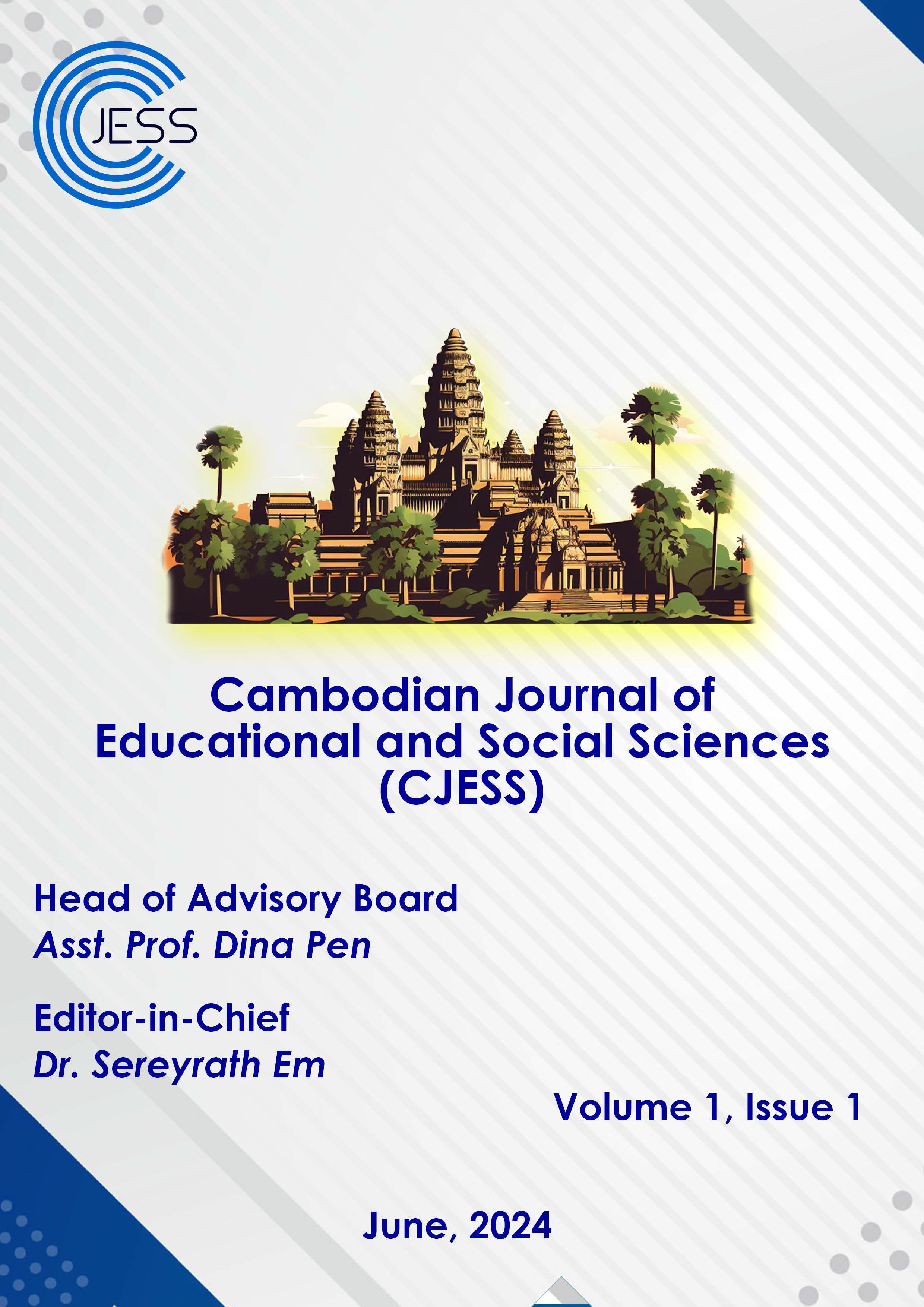
Groundbreaking issue of the Cambodian Journal of Educational and Social Sciences (CJESS)
DOI:
https://doi.org/10.69496/cjess.v1i1.4Keywords:
Academic rigor, Cambodia, Educational development, Scholarly publishing, Social science researchAbstract
The Cambodian Journal of Educational and Social Sciences (CJESS) is an academic journal that releases original research articles, review articles, and book reviews twice a year in June and December. This latest journal utilizes an open-journal system (OJS) for its publishing procedures, possibly being the pioneer among a few journals in Cambodia employing this system. The journal's goals and objectives focus on enhancing research and publication quality in Cambodia and other places. By doing so, we believe that we can help push Cambodia's research quality and publication into the international arena. Therefore, this article provides a comprehensive overview of the journal, highlighting its editorial board, reviewers, contacts, focus and scope, peer review process, publication frequency, open-access policy, publication ethics, plagiarism screening, free of charge, indexing and abstracting, author guidelines, reviewer guidelines, copyright notice, privacy statement, and manuscript template, all of which we are committed to enhancing for the benefit of Cambodia. Furthermore, we reserve the right to edit this information in the future to enhance the journal's quality and effectiveness. The article also emphasizes the journal's impacts and contributions, its future direction and vision, its acknowledgments and appreciations, and its call for action. The illustrated information in this journal is the only essential thing. The journal's website and its contacts provide direct descriptions of the remaining information.
Downloads
References
Arumugam, A., Mehta, P., & Baxter, G. D. (2020). Double-blind peer review of manuscripts: Opportunities, challenges, and way forward. Physical Therapy Reviews, 25(1), 1–6. https://doi.org/10.1080/10833196.2019.1698161
Bus, S. A., Monteiro‐Soares, M., Game, F., Van Netten, J. J., Apelqvist, J., Fitridge, R., Senneville, E., Schaper, N. C., & IWGDF Editorial Board. (2024). Standards for the development and methodology of the 2023 IWGDF guidelines. Diabetes/Metabolism Research and Reviews, 40(3), 1–10. https://doi.org/10.1002/dmrr.3656
Em, S. (2023). Two years for an English teacher to become a novice educational researcher: Author’s experiences from writing opinion articles to research articles. Journal of Mathematics Instruction, Social Research and Opinion, 2(1), 35–54. https://doi.org/10.58421/misro.v2i1.59
Em, S. (2024a). The scholarly corpus of a Cambodian author predominantly comprises a selection of works published in 2023, primarily searchable on Google Scholar. International Journal of Cambodian Education (IJCE), 2(1), 1–18. https://englishacademicessay.org/2024/01/02/the-scholarly-corpus-of-a-cambodian-author-predominantly-comprises-a-selection-of-works-published-in-2023-primarily-searchable-on-google-scholar/
Em, S. (2024b, January 19). About Editor-in-Chief. English Academic Essay (EAE). https://englishacademicessay.org/about-editor-in-chief/
Em, S. (2024c, April 15). A journey of innovation: A biographical study of Dr. Sereyrath Em’s work update of April 2024. English Academic Essay (EAE). https://englishacademicessay.org/2024/04/15/a-journey-of-innovation-a-biographical-study-of-dr-sereyrath-ems-work-update-of-april-2024/
Grimm, R., Fox, C., Baines, S., & Albertson, K. (2013). Social innovation, an answer to contemporary societal challenges? Locating the concept in theory and practice. Innovation: The European Journal of Social Science Research, 26(4), 436–455. https://doi.org/10.1080/13511610.2013.848163
Heng, K., & Sol, K. (2021). Academic research in Cambodia: Progress, challenges, and ways forward. Cambodian Journal of Educational Research, 1(2), 6–23. https://doi.org/10.62037/cjer.2021.01.02.02
Heng, K., & Sol, K. (2022). Education: Key to making Cambodia great again. Kimkong Heng, 4(3), 1–18. https://www.cd-center.org/education-key-to-making-cambodia-great-again/
Heng, K., Hamid, M. O., & Khan, A. (2022). Academics’ conceptions of research and the research-teaching nexus: Insights from Cambodia. International Journal of Educational Development, 90(2022), 1-11. https://doi.org/10.1016/j.ijedudev.2022.102569
Heng, K., Hamid, M. O., & Khan, A. (2023). Research engagement of academics in the Global South: The case of Cambodian academics. Globalization, Societies and Education, 21(3), 322–337. https://doi.org/10.1080/14767724.2022.2040355
Heng, K., Hamid, Mo., & Khan, A. (2021). Factors influencing academics’ research engagement and productivity: A developing countries perspective. Issues in Educational Research, 30(3), 965–987. https://doi.org/10.3316/informit.465283943914964
Hollmann, S., Frohme, M., Endrullat, C., Kremer, A., D’Elia, D., Regierer, B., Nechyporenko, A., & on behalf of Cost Action CA15110. (2020). Ten simple rules on how to write a standard operating procedure. PLOS Computational Biology, 16(9), 1–10. https://doi.org/10.1371/journal.pcbi.1008095
Luminous Insights. (n.d.). For editors. https://luminousinsights.net/pages/for-editors
Makel, M. C., & Plucker, J. A. (2014). Facts are more important than novelty: Replication in the education sciences. Educational Researcher, 43(6), 304–316. https://doi.org/10.3102/0013189X14545513
Misra, D. P., & Agarwal, V. (2020). Integrity of clinical research conduct, reporting, publishing, and post-publication promotion in rheumatology. Clinical Rheumatology, 39(4), 1049–1060. https://doi.org/10.1007/s10067-020-04965-0
Mohajan, H. K. (2018). Qualitative research methodology in social sciences and related subjects. Journal of Economic Development, Environment and People, 7(1), 23–48. https://www.ceeol.com/search/article-detail?id=640546
Perkins, M., Gezgin, U. B., & Roe, J. (2020). Reducing plagiarism through academic misconduct education. International Journal for Educational Integrity, 16(1), 1–15. https://doi.org/10.1007/s40979-020-00052-8
Powney, J., & Watts, M. (2018). Interviewing in educational research (1st ed.). Routledge. https://doi.org/10.4324/9780429503740
Resnik, D. B., & Elmore, S. A. (2016). Ensuring the quality, fairness, and integrity of journal peer review: A possible role of editors. Science and Engineering Ethics, 22(1), 169–188. https://doi.org/10.1007/s11948-015-9625-5
Seeber, M., Klemenčič, M., Meoli, M., & Sin, C. (2023). Publishing review reports to reveal and preserve the quality and fairness of the peer review process. European Journal of Higher Education, 13(2), 121–125. https://doi.org/10.1080/21568235.2023.2192549
Sierra‐Martínez, S., Martínez‐Figueira, M., Castro Pais, M. D., & Pessoa, T. (2024). ‘You work, I copy’. Images, narratives and metaphors around academic plagiarism through Fotovoz. British Educational Research Journal, 1–19. https://doi.org/10.1002/berj.3977
Springer. (n.d.). Editorial boards. https://www.springer.com/it/authors-editors/editors/editorial-boards
Wickert, C., Post, C., Doh, J. P., Prescott, J. E., & Prencipe, A. (2021). Management research that makes a difference: Broadening the meaning of impact. Journal of Management Studies, 58(2), 297–320. https://doi.org/10.1111/joms.12666